How to measure stairs for carpet, accurate stair measurements for carpet, underlay and gripper.
Measuring stairs is one of the most confusing parts of buying carpet — but it doesn’t need to be.
This simple guide walks you through everything you need to measure straight steps, turned steps and landings so you can calculate the correct amount of carpet every time.
🧰 What you’ll need.
Tape measure (metric)
Pen and notepad (or your phone)
Calculator (or the FloorCalc Carpet Calculator)
Access to the full staircase.
Someone to help (optional but makes it easier)
1- How to measure straight stairs
Straight stairs are the easiest.
Every step usually has the same measurements.
Step 1- Measure the tread
Measure the depth of one step (front to back).Typical range: 25–30cm.
Step 2- Measure the riser
Measure the height of the step.Typical range: 17–20cm.
Step 3- Add riser and tread together
This gives the length of carpet needed per step. Example:
Tread: 28cm.
Riser: 18cm.
Total per step: 46cm.
Step 4- Measure the width of the stair
Measure the widest point from left to right.
Most UK stairs:
80–90cm.
Add 2–3cm extra for trimming.
Step 5- Count the number of stairs
Multiply the total length per step by the number of steps.
Example:
46cm per step.
13 steps.
46 × 13 = 598cm (5.98m)
Steps can be fitted in groups of 1,2,3,4 etc, end finish should remain the same.
2- How to measure turned stairs (winder stairs)
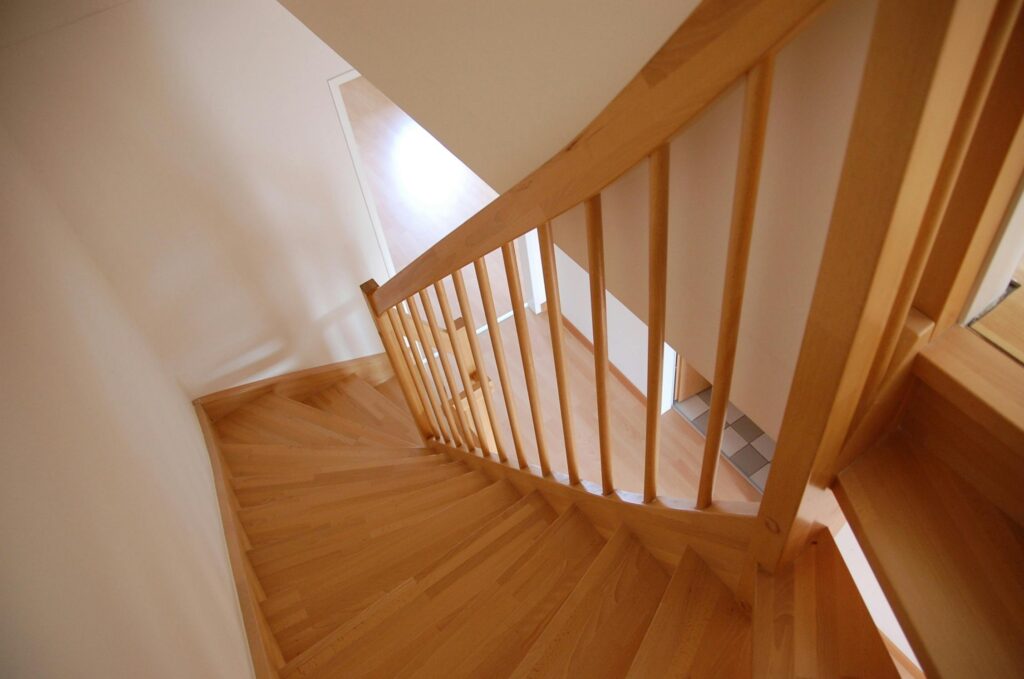
Winder stairs have triangular or curved steps. To measure these:
Step 1- Measure the widest point of each winder
Stand on the step and measure from the inner point to the outer edge.
Step 2- Measure tread and riser
Same as straight stairs, but do it individually for each winder, as they often differ.
Step 3- Add 5-10cm extra
Winders require extra carpet because of shaping and trimming.
Step 4- Total everything
Add straight stairs + winder stairs together.
3- How to measure landings
Small landing at the top or bottom.
Measure length × width.
Landings usually require one rectangular piece. Quarter or half landings (turning landings)
Measure each landing separately:
Example landing:
120cm × 90cm.
Total: 1.08m²
Add this to your stair total.
4- Add wastage and fitting allowance
Stairs require more wastage than flat rooms.
Add: 10% for straight stairs.
15–20% for winder stairs.
Extra 10cm for top/bottom landings.
This allows for:
Pattern matching.
Trimming.
Fitter shaping
5- Use FloorCalc to double check your measurements
You can use the Carpet Calculator to estimate:
Total m² needed.
Underlay required.
Gripper rods required.
Estimated cost.
We also have the stair carpet cutting plan generator to help with calculating how much carpet you need.
6- Do you need underlay and gripper?
Underlay:
Each step uses roughly the same measurements as the carpet.
Always fit underlay on stairs for safety and comfort.
Gripper:
You’ll need approximately 2 pieces per step (tread and riser).
Example staircase calculation
13 straight steps.
Tread: 28cm.
Riser: 18cm.
Width: 90cm.
1. Step length = 28 + 18 = 46cm.
2. 46cm × 13 = 598cm (5.98m)
3. Add landing (e.g., 1m × 1m = 1m²)
4. Add 10% wastage = 6.6m approx.
Final carpet needed: ~6.5–7m depending on roll width.
Useful links
For more help, check out:
Understand how to calculate tile quantities, plan layouts, and avoid wastage with a clear step-by-step guide.
How to calculate tiles without wasting
Learn the simplest method to measure any room accurately using UK flooring standards — perfect for carpet, laminate, vinyl, and trade work.
How to Measure a Room for Flooring
Wondering in you need a plywood subfloor? Our guide tells you everything you need to know.
You can also try our tile calculator, plywood Calculator paint calculator, carpet calculator and Laminate flooring calculator for other projects.
Related calculators